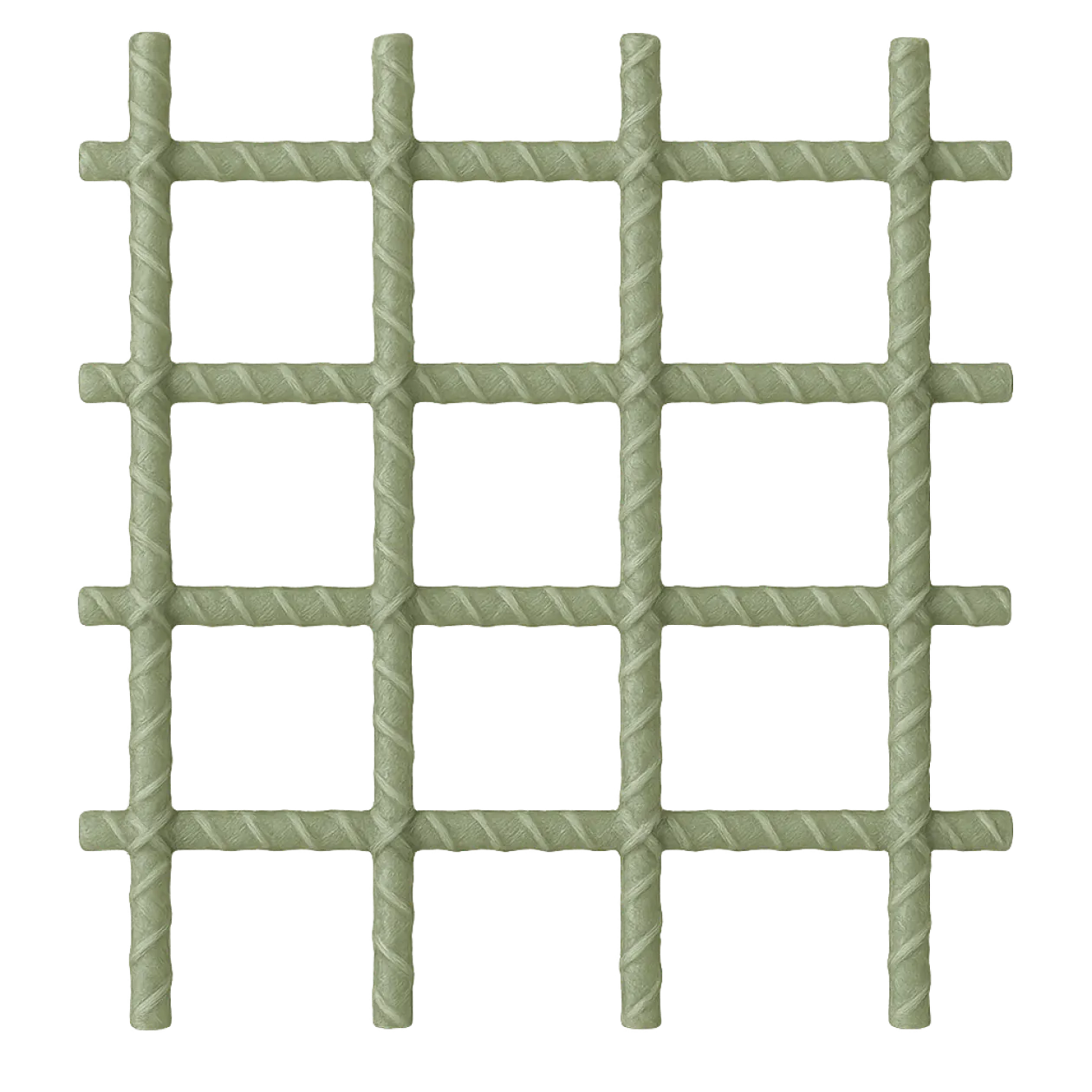
GFRP Mesh
In modern construction, GFRP mesh (Glass Fiber Reinforced Polymer mesh) represents an innovative and versatile solution. Its combination of corrosion resistance, lightweight design, and robust strength not only improves concrete quality but also streamlines construction processes, reduces maintenance costs, and extends the lifespan of buildings.
Applications
Application of Composite Mesh

  • Reinforcement of concrete structures and mixed reinforced concrete structures

  • Structures located in coastal areas, airports, hospitals, military bases and more

  • Special purpose objects (power plants)

  • Weight sensitive structures

  • Road industry (construction of bridges, roads, tunnels)

  • Heat/cold sensitive environments (basements, patio decks)

  • Civil projects (commercial & residential buildings, high rises)
Benefits of GFRP Mesh
Corrosion Resistance
GFRP mesh will not rust, even in the harshest environments. Unlike steel mesh, FRP mesh ensures a longer lifespan and minimizes maintenance needs.
Highly Chemical Resistance
GFRP mesh resistant to salt ions, acids, chemicals, and the inherent alkalinity of concrete. This is important when you build concrete structures in coastal areas near seas, oceans, lakes and rivers.

Lightweight
GFRP rebar is 9 times lighter in weight than the equivalent strength of Steel rebar.
Strength
Fiberglass rebar has 3 times stronger tensile strength than steel. GFRP has substantially greater bond strength to concrete than steel which makes GFRP-reinforced concrete more resistant to cracking.
GFRP Mesh vs. Steel Mesh


Characteristics
GFRP Mesh
Steel Mesh
Diameter of the rod (wire), mm
2.5
4.0
Breaking strength, MPa
1300
570
Breaking tension of the rod, kgf
600
720
Coefficient of elongation, %
2.50
2.50
Coefficient of heat conductivity, W/(m*°C)
0.46
56.00
Electric conductivity
Non-conductive
Conductive
Thermal conductivity
Low
High
Corrosion resistance
High (unaffected by water)
Low (without expensive galvanisation treatment bars of steel are subject to oxidation)
Heavy load resistance
No permanent deformation
Can be permanently deformed
Magnetic characteristics
Does not magnetize
Susceptible to
Costs
Lower manufacturing costs, maintenance costs, and transportation expenses (related to lightweight)
Lower material costs but higher overall costs of production, transportation, installation, and technical maintenance
Grid Cell
Production Diameter, mm
Weight, kg/SQMT
50 X 50
4
0.78
100 X 100
4 - 6
0.41 - 1.11
150 X 150
4 - 6
0.28 - 0.7
200 X 200
4 - 6
0.2 - 0.54
Advantages of using GFRP Mesh
GFRP mesh represents an evolution of steel mesh rebar and makes the GFRP composite technology applicable in construction in practically every of its construction. Composite reinforcement mesh is sustainable and shows prevailing results. The use of FRP mesh in various construction projects not only enhances structural integrity but also opens new possibilities for innovative design and more efficient construction practices.

Reduction of Rebar Scrap
Easily Cut & Machined
Easy and Rapid Installation Time

Lower Transportation & Storage Costs
Reduced whole-life Project Costs
Benefits of Composite Rebar
Excellent Corrosion Resistance
GFRP rebar effectively resists corrosion and so can last much longer than standard rebar. Composite rebar minimizes maintenance needs.
Highly Chemical Resistant
GFRP rebar resistant to chemical acids, salt ions, and the inherent alkaline bases of concrete that cause premature deterioration.

Lightweight
GFRP rebar is 9 times lighter than steel, making it easier to transport and install.
High Strength
Despite its lightweight properties, GFRP rebar offers impressive strength-to-weight load-bearing performance.
A Complete Technical Comparison
GFRP Rebar vs Steel Rebar
In modern civil engineering and infrastructure development, the selection of reinforcement material has a profound impact on the durability, cost, and overall performance of concrete structures. Traditionally, steel rebar has been the dominant choice due to its strength and availability. However, Glass Fiber Reinforced Polymer (GFRP) rebar has gained considerable attention in recent years as a superior alternative for specific applications. This article presents a comprehensive, data-driven comparison of GFRP vs. steel rebar, considering mechanical properties, durability, weight, economic impact, and project-specific examples.
Mechanical Properties Comparison
Mechanical strength is the primary factor when choosing reinforcement. Below is a comparison table of the key mechanical characteristics

Property Steel Rebar
(A615 Gr.60) GFRP Rebar
Tensile Strength
~550 MPa 1000–1500 MPa
Modulus of Elasticity
~200 GPa 60–80 GPa
Yield Strength
~500 MPa Not Applicable (brittle)
Density
O~7850 kg/m³ ~1900 kg/m³
Choose G-Bar Rebar and Mesh!
100% Corrosion-Resistant . Durable . Lightweight
2025 G-BAR. All right reserved